There's no any particular cpm rate, all the rates are highly dynamic and different for each site and user. tech news: computernews  
lasted technology news
news...
 
Showing posts with label computernews. Show all posts

Sunday, July 16, 2017

Microsoft issues fix for new Surface Pro hibernation issue

surfaceprobugfixed.jpg
Microsoft is confirming that a firmware update the company released on July 13 is meant to fix the hibernation/sleep bug reported by some owners of the newest Surface Pro devices.
Microsoft rolled out a firmware update for the Surface Pros yesterday, July 13, that was labeled as revising system power reporting. There is/was no additional information about what that meant.
But on the Microsoft Answers thread about the Surface Pro 2017 random hibernation problems, Microsoft provided an update on July 14 as to what's in that firmware update.
"7/14 Update: The fix for this issue has completed testing and is now live, please go update your Surface Pro via Windows Update to get the latest download. You can obtain this fix by checking Settings > Update & security > Windows Update," said Microsoft representative "BryanH."
On July 10, Microsoft officials said they had identified the issue causing some users' Surface Pro machines to randomly hibernate/sleep. Officials said at that time they were testing a fix for it which they'd deliver via Windows Update. On July 12, BryanH said on the Microsoft Answers forum that Microsoft had not yet included the fix in the latest bunch of updates delivered this week on Patch Tuesday.
Microsoft introduced the newest member of its Surface family, the Surface Pro -- which it is positioning as its "most versatile laptop" -- in late May. The device is the successor to the Intel-based Surface Pro 4.
Some unknown number of Surface Pro users began reporting in late June that they were having hibernation/sleep issues with the new devices.
Stretchy, bendy, breakthrough nanotech material brings touch control to any surface
Finnish nanotechnology company Canatu has developed a stretchable, malleable, and touch-sensitive material that brings in flexible new designs for everything from wearables to car dashboards.

Sunday, June 18, 2017

Apple MacBook Pro with Touch Bar (13-inch, 2017) review: Faster but still expensive | tech news


It's barely six months since Apple revamped the entire MacBook Pro range, introducing the eye-catching Touch Bar on several models -- along with eye-watering price rises, courtesy of Brexit. So the new models introduced at Apple's World Wide Developer Conference this month merely provide what Apple terms 'a refresh'. There was a new 'entry-level' version of the MacBook Pro - a 13-inch model without a Touch Bar that now starts at a still hefty £1,249 (inc. VAT). The high end of the range gets a boost with improved GPUs on the 15-inch models, reflecting Apple's belated discovery of virtual reality. However, the mid-range 13-inch MacBook Pro reviewed here merely gets a bit of a speed-bump, courtesy of Intel's 7th generation Kaby Lake processors.

There are two 13-inch Touch Bar models, as before, both of which retain the impressive slimline design of their predecessors. At just 14.9mm thick, 304mm wide, and 212.4mm deep, the MacBook Pro is quite a bit smaller than my ageing 13-inch MacBook Air, and only fractionally heavier, at 1.37kg. Prices start at £1,749 (inc. VAT, £1,457.50 ex. VAT, or $1799) with a dual-core Core i5-7267U processor running at 3.1GHz -- compared to the 2.9GHz of the 2016 edition -- along with 8GB of RAM and a 256GB solid-state drive.

We tested the second configuration, which simply doubles the solid-state drive to 512GB, and costs £1,949 inc. VAT, £1,624.17 ex. VAT, or $1,999). Apple's build-to-order options are always pricey, but the lack of upgradeability means that it's wise to purchase the highest specification you can afford. Options available here include 3.3GHz or 3.5GHz processors for an extra £90 ($100) and £270 ($300) respectively; you can also double the memory to 16GB for a further £180 inc. VAT, £150 ex. VAT, or $200).

The attractive 13.3-inch Retina Display remains unchanged, with 2,560-by-1,600-pixel resolution (227dpi), although it still relies on Intel's integrated Iris Plus 650 for graphics work. That's our main criticism of the 13-inch MacBook Pro models, since a laptop costing well over £1,700 really ought to have a discrete GPU -- especially if Apple genuinely wants to be taken seriously by VR developers. And if you're going to charge a premium for a professional-quality display that supports features such as the DCI-P3 colour-space, then you need to provide professional-level graphics performance to match.

That said, Intel's integrated GPU acquits itself well, managing a respectable 41.6 frames per second when running the Cinebench R15 graphics benchmark. The Kaby Lake update for the main CPU is no slouch either, producing single- and multi-core Geekbench 4 scores of 4409 and 9255 respectively, compared to 3797 and 7540 for its Skylake predecessor -- an increase of almost 23 percent for multi-core performance.

Battery life is respectable, but not outstanding, and Apple's claim of 10 hours seems a little optimistic. The 500-nits Retina Display is so bright and clear that we were able to lower the brightness to 50 percent during our battery tests, which allowed the MacBook Pro to last for seven hours and fifteen minutes when streaming video off BBC iPlayer. If you're not online all day long then you should certainly get a full day's work out of the laptop, although the 10-plus hours that I get from my MacBook Air is still hard to beat.

article source : zd.net

Inside Microsoft's Surface Laptop and Surface Pro

According to iFixit, Microsoft's Surface Laptop is not a laptop. It's a glue-filled monstrosity.
The iFixit team is impressed by Microsoft's new Surface Laptop and Surface Pro. That is, impressed by the fact that the devices are "so much worse than we expected."
So, what did the iFixit team not like about Microsoft's latest crop of devices? Well, it all comes down to repairability, or the lack thereof.

After being pleasantly surprised by the upgradability of Apple's new iMac (even though that device scores pretty poorly on the repairability front, and was described as being "distinctly un-fun to open"), the iFixit team seem to be shocked to discover how unrepairable Microsoft's new devices are.

"No matter how hard you try, you'll never be able to fix or change them (unrepairable and non-upgradable)," is how the company described them in a statement to ZDNet.

iFixit
The Surface Laptop was described as "a glue-filled monstrosity" that "literally can't be opened without destroying it" because the components are "hidden under adhesive and plastic spot welds" while the Surface Pro was found to be "nearly identical to its predecessor--aside from ditching the last remaining upgradable component, the modular SSD."

Now not many buyers will care about repairability (part of the reason why modern devices are so hard to repair), but that lack of a modular SSD in the Surface Pro means that there is no way to recover data from a bricked device.
But the teardown did reveal some positive changes.

The Surface Pro gets a battery boost to a four-cell, 45 Wh unit, up from a two-cell 38.2 Wh battery in the Surface Pro 4, has a redesigned hinge to give it an extra 15 degrees of range, up to a 165-degree angle, and has an upgraded cooling system and redesigned cooling vents in the case.

Coming to the Surface Laptop, apart from the layout of the ports, it's surprisingly similar (externally) to Apple's MacBook Air, with the biggest difference that it trades a second USB port for an SDXC card reader. The heat dissipation system also looks very beefy, and can dissipate heat from both sides of the motherboard.

So what does this mean? Well, the bottom line is that any damage, even slight damage, is probably going to put both the devices out of action, and it's unlikely that it can be fixed. If that's something that worried you, then it's worth bearing in mind. If not, then don't worry about it.

Saturday, June 17, 2017

15 best PC gaming headsets 2017- DESCOVER NOW

Every PC gamer wants the best picture. After all, there’s nothing like a curved, ultra-wide or 4K monitor to really make for a top-notch immersive experience. But what about the best sound? As gamers flock to the latest graphics cards, processors, mice and keyboards, the best PC gaming headsets often fly under the radar. Because they’re “optional”, you have a bit of leeway to skimp when it comes to audio.

That won’t be the case for long, however. Where competitive games like Overwatch have overtaken the PC gaming scene, it’s more essential than ever to have the best PC gaming headset as you coordinate with allies through an onboard mic and listen for enemies around the corner. As such, it’s become increasingly integral that you upgrade your sound system accordingly. Features such as virtualized 7.1 surround sound, 5.8GHz wireless tech and, most importantly, RGB lighting are not to be missed.

Here we’ve gathered the 15 top PC gaming headsets from all corners of the globe. Some, like the Asus ROG Centurion 7.1, are focused on delivering only the highest quality sound while others, like the Razer ManO’War, for example, prioritize ease of use. No matter how stringent your exact demands from your next PC gaming headset, you can be sure that one of the best PC gaming headsets below will meet those requirements with flying colors.
1. Razer ManO'War

Surround sound without the fuss

Interface: Wireless | Features: Software-based 7.1 surround sound, earcup-mounted controls, Chroma RGB multi-color lighting, 14-meter range (using an extender, 12 meters without)

$100.23
VIEW AT AMAZON
$100.23
View at Newegg
$100.23
View at Amazon Marketplace
See all prices (35 found)
Great surround soundEasy to set upMulti-color lightingSlightly bulkyNo wired option
Quick and easy to setup using a wireless USB receiver that stores inside the headset for transportation, the Razer ManO'War is a user-friendly unit primed for surround-sound gaming. Sure, it's a little chunkier than most other headsets, but two soft leatherette ear cups make it comfortable to wear for extended periods. And, with Chroma RGB lighting customizable through Razer Synapse, it even looks snazzy to observers.

Although it’s a software feature rather than hardware, the ManO'War's 7.1 channel virtual surround sound does a fine job of ramping up immersion in-game. The ManO'War's range can reach up to 14 meters using the supplied USB extender, and its battery life is capable of stretching to just as many hours.

If you don’t plan on moving that far from your computer, there’s a wired version too. Supplied with a USB digital-to-analog converter (CAV), the cable-attached Razer ManO’War 7.1 sounds every bit as sexy as it looks, even if RGB backlighting is nowhere to be seen.

Read the full review: Razer ManO'War


2. Asus ROG Centurion 7.1

10 drivers, 7.1 channels, one impeccable headset

Interface: Wired (USB) | Features: 10-driver 7.1 surround sound, dual-USB amplifier, Sonic Software compatibility, HDMI passthrough, amplifier with audio profile and channel volume controls, unidirectional microphone

$269.99
VIEW AT AMAZON
$269.99
View at Amazon Marketplace
€248.14
View at Amazon Germany
See all prices (6 found)
Excellent spatial soundSpeaker passthroughCan only be used with its ampHeavy and bulky
Neglecting all the unwritten rules of fashion, the ROG Centurion 7.1 is a spectacle to behold. Though it’s a living hellscape to set up, this gaming headset delivers both extreme looks and an unruly knack for emitting crystal clear sound waves. It may require a cumbersome preparation procedure involving a pair of USB cables and an amplifier, but that’s not to say the ROG Centurion 7.1 doesn’t offer plenty of room for expansion.

In fact, the Asus ROG Centurion 7.1 not only bolsters full-fledged surround sound passthrough for an external set of speakers, but the onboard amp controls grant you complete control over the audio profiles and channel volumes being outputted. You can even take advantage of Asus’s own Sonic Studio software package, which gives you even more dominance over the headset’s functions. There’s a steep learning curve, but for those who don’t mind, this headset is a mighty surround sound offering.

Read the full review: Asus ROG Centurion 7.1 headset


3. V-MODA Crossfade Wireless

Stylish with powerful bass-driven tones

Interface: Wireless or wired (USB) | Features: Bluetooth connectivity, built-in microphone (Boom Microphone available for gamers), lithium-ion battery with up to 12 hours of continuous music, dual-diaphragm 50mm driver, metal construction with leather, military-level MID-STD-810 tested

$270
VIEW AT AMAZON
$270
View at Amazon Marketplace
€245
View at Amazon Spain
See all prices (45 found)
Huge, eardrum-filling soundComfortable padded cupsDivisive designDon't fold
If you're more interested in the sounds coming out of your gaming headset rather than glowing LEDs, macro keys and other gratuitous extras, then the V-MODA Crossfade Wireless is the headset for you. Its stylish cans are a treat for the ears, booming with sound that's bass-heavy with fantastically crisp treble at the other end.

Stepping out of the soundscape for a moment, the V-MODA Crossfade Wireless features memory foam ear cups that are both comfortable and spacious without inciting irritation after prolonged use. What’s more, you'll get around 12 hours out of its battery life when connected via Bluetooth. This headset's rugged build quality, funky travel case and optional USB connectivity add up to make it one of the best headsets on the market.

Read the full review: V-MODA Crossfade Wireless


4. Astro A50 Wireless

The best general use headset just got better

Interface: Wireless | Features: Dolby Digital 7.1 surround sound; Works with PS4, Xbox One, Xbox 360, PS3, PC, and mobile; Astro Audio; 5.8GHz wireless tech with MixAmp; 6.0mm uni-directional noise cancelling mic; USB charging with base station

$232.95
VIEW AT AMAZON MARKETPLACE
$298.95
View at Amazon
€199.18
View at Amazon Spain
See all prices (45 found)
Full-bodied Dolby 7.1 Surround soundSupremely comfortableFinnicky charging cradle
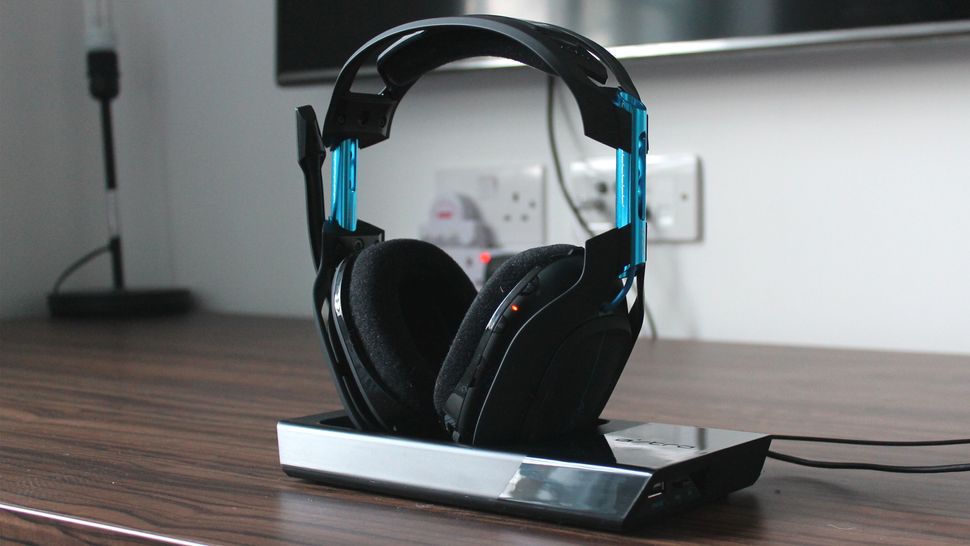
We called the original Astro A50 a "game-changing, experience-enhancing headset," and thankfully its wireless successor follows the "if it ain’t broke, don’t fix it" rule. Astro's latest headset does what it says on the tin and adds wireless connectivity to an already stellar package. Though not the cheapest headset on the block, the Astro A50 Wireless has transferred amp controls from its predecessor's cable right into the headcups themselves to balance in-game audio and voice chat on-the-fly.

Add to that the A50's solid aluminum construction, effective noise-cancelling microphone, booming bass and impressive mid-range sounds, and here you have a headset that's compatible with a range of different platforms. Not only is it ready to rock with your PC, but with PS4, Xbox One and legacy consoles as well.

It's also suitable for using with the HTC Vive and other VR headsets, thanks to the accommodating shape of the headband. We've found that few headsets can rival the comfort of the A50’s plush ear cups, which are large enough to give you a realistic sense of sound coming from all directions.


5. SteelSeries Siberia 840

A fantastic all-rounder

Interface: Wireless or wired | Features: Closed back earcups, Dolby virtual 7.1 surround sound, retractable directional mic with mute indicating light, two hot-swappable Li-Ion batteries, SoundShare audio recording, click wheel, memory foam ear cushions, compatibility with Xbox 360, PS3/4, PC/Mac, Apple TV/Roku, home entertainment and mobile devices

$329.99
VIEW AT NEWEGG
$358.63
View at Amazon
€49.99
View at Amazon Germany
See all prices (14 found)
Dolby 7.1 surround soundComfortablePricey
Sometimes you're prepared to pay a premium for a PC gaming accessory that does the lot, and in the headset category that's the Siberia 840. Following in the footsteps of the already impressive Siberia 800, the upgraded Sibera 840 is pro-Bluetooth, anti-lag and all about personalization. With the SteelSeries Engine 3 app, you can customize everything from equalizer settings to what you want shown on the OLED screen of the accompanying base unit.

All of that is, of course, secondary to the Siberia 840's sound qualities which are nothing less than sublime. Activating Dolby 7.1 surround sound is like dropping you into the game. Enemies' footsteps can be picked out across a room including behind you, leading to some heart-in-mouth moments in gorey shooters like Doom.


6. Turtle Beach 350 Stealth VR

The best gaming headset for virtual reality

Interface: Wired (3.5mm) | Features: Battery-powered amplification (30 hours on a single charge), variable bass boost, full-range audio, mic monitoring, removable noise-cancelling microphone, ergonomic VR design. swappable cable system

$54.63
VIEW AT AMAZON
$54.63
View at Amazon Marketplace
$59.99
View at Newegg
See all prices (12 found)
Ergonomic design suits VR headsetsBattery amplification provides full-bodied soundMic monitoring lets you hear yourselfFeel flimsier than more expensive headsetsNo surround sound
With VR headsets like the HTC Vive and Oculus Rift making their way into PC gamers' rooms, specially-designed audio headsets for virtual reality were bound to follow. The Turtle Beach 350 Stealth VR is one of the most flexible out there, featuring a generous amount of adjustability thanks to its sturdy headband which can fit over the top of VR headsets worn on even the biggest heads.

Sure enough, the 350 Stealth is designed for practicality rather than sharp looks. Its black-and-white color scheme isn't the most exciting design out there, but an abundance of features makes up for that. There's mic monitoring, which allows you to hear your own voice inside the headset, bass boost for booming lows, a detachable noise-cancelling headphone mic, and a groove in the ear cups that lets you tuck the audio cable out of the way. While it's perfectly suitable for owners of PC-based VR headsets, it's quite literally a great fit for PSVR gamers too.


7. SteelSeries Arctis

High performance with a low profile

Interface: Wireless or wired (3.5mm) | Features: 2.4GHz wireless technology (Arctis 7 only); 15-hour battery; built-in digital audio control; Virtual 7.1 Surround Sound; Steelseries Engine software, Compatible with PC, Mac PS4, Xbox One, smartphones, tablets and VR

$69.99
VIEW AT AMAZON
$69.99
View at Amazon Marketplace
$74.99
View at Newegg
See all prices (41 found)
Sterling bass and treble qualityProfessional designUgly suspension headband
Unlike some of its competitors, SteelSeries stresses subtlety in its headset designs. The Arctis continues this trend by flaunting sound quality and comfort over gaudy appearances.

When you pop an Arctis on your head, the goal is for, say, your stream audience to see a professional environment rather than, say, a Dorito stain on your chair. The customizable lighting gives you plenty of wiggle room, in case the whole monochrome look isn’t your thing.

The SteelSeries Arctis comes in three distinct flavors: Arctis 3, Arctis 5 and Arctis 7, each one more expensive than the last. The Arctis 3 is par for the course analog protocol while the 5 ships with an external digital-to-analog converter (DAC). The Arctis 7, meanwhile, is wireless by way of 2.4GHz connectivity. Each model comes stacked with built-in audio control enhanced even further by the SteelSeries Engine 3 app.


8. HyperX Cloud Stinger

Better sound for the buck

Interface: 3.5mm analog wired | Features: Closed back earcups, swiveling noise-cancellation microphone, onboard volume slider, multi-platform compatibility, memory foam earcups

$49.99
VIEW AT AMAZON
$49.99
View at Newegg
$49.99
View at Amazon Marketplace
See all prices (12 found)
LightweightExcellent ergonomicsUnremovable microphoneLight on bass
Arguably one of the most affordable gaming headsets available today, the HyperX Cloud Stinger is designed to give players eSports quality audio at a bargain. While there isn't much to write home about with the red on black plastic design of the headset, 50mm directional drivers make the stereo superb. That goes without mentioning the noise-cancelling mic, which aims to keep your obnoxiously loud background music where it belongs: in the background.

Because it features volume control on the earcup itself, you’ll never have to be an awkward keystroke away from turning the sound up. Moreover, thanks to the lightweight design, the HyperX Cloud Stinger is comfortable to wear for extended play sessions, thanks to a set of memory foam earcups that rotate 90 degrees. Although this isn't the ultimate PC gaming headset, it's a great starting point for those on a budget.


9. Sennheiser GSP 350

Stellar Sennheiser audio quality for less

Interface: 3.5mm and USB (for 7.1 surround) | Features: Closed acoustic earcups, memory foam ear pads, right ear cup volume control, 7.1 Dolby surround sound, broadcast quality noise-cancelling microphone, automatic mic mute, split headband design

$137.15
VIEW AT NEWEGG
$138
View at Amazon
$138
View at Amazon Marketplace
See all prices (9 found)
Dolby 7.1 Surround SoundSturdy build qualityComfortable memory foam earpadsDolby surround only works with PC
More affordable than Sennheiser's flagship PC 373D while still packing an audible punch, the GSP 350 carries over that headset's stellar 7.1 Dolby surround sound and closed ear cup design. It's equally a suitable for marathon gaming sessions thanks to its huge comfortable ear cups, with the right cup once again featuring a volume dial.

The headset uses a closed-back design with an adjustable split headband rather than the PC 373D's more solid and thicker continuous band. Much to the relief of your in-game teammates, there’s a noise-cancelling microphone in place as well that both mutes when lifted up and automatically detects/omits breathing sounds. If you like the look of Sennheiser's flagship gaming headset but can't quite stomach the price, the GSP 350 is the “lite” version.


10. Logitech G933 Artemis Spectrum

A command center on your head

Interface: Wireless or wired (3.5mm) | Features: 7.1 surround sound, cup-mounted G-keys (macro), programmable RGB mutli-color lighting

$134.68
VIEW AT AMAZON
$134.68
View at Amazon Marketplace
$149.99
View at Newegg
See all prices (7 found)
Attractive designCup mounted macro keysComfortableAverage battery life
Logitech's flagship gaming headset packs in plenty of bells and whistles, the most useful being its cup-mounted G-keys that provide handy shortcuts to performing actions in-game. In terms of design, The G933 is certainly one of the snazziest headsets around, practically oozing gamer appeal. And, if you're fed up of round ear-cups on headsets then you'll appreciate its large and comfortable ear-shaped ones.

Logitech has ran a multi-colored lighting strip all the way down the cup, rather than placing a flashing logo on the side, which in our eyes is more appealing than the smaller, contained glowing areas on Corsair's and Razer's flagship headsets. The downside is that this limits battery life to around 10 hours, though you can turn it off to eke out a few more. For a USB gaming headset, it’s impressively multi-platform too, working across PS4, Xbox One and Windows PCs.


11. Corsair Void RGB

Lights up the room and your ears

Interface: Wireless or wired (USB) | Features: 7.1 software-based surround sound, 2.4GHz wireless, 40-feet wireless range, 16-hour battery life, mic-on indicator, RGB lighting, Corsair CUE software, 50mm neodymium drivers, noise-cancelling microphone

$79.82
VIEW AT AMAZON
$79.82
View at Amazon Marketplace
$79.99
View at Newegg
See all prices (22 found)
Well-builtLong wireless rangeSurround sound works wellCloth (rather than leather) ear cupsMicrophone isn't great
The Corsair Void RGB is super comfy, boasting an ear-shaped design in favor of the usual round cans that almost never feel right. It’s also capable of exuding first-pumping bass that’s powerful without muddying the mix. You can configure its lighting colors using Corsair's intuitive software and even make it dance in tandem with the company's K65 or K70 mechanical keyboards.

Plus, you can take solace in the fact that the Corsair Void RGB has a 2.4GHz wireless range of up to 40 meters. No more worrying about the chatter cutting off when you get up to grab your beer.  Unfortunately, there isn't any way for adjusting the fold-down mic so its clarity often suffers, but it doesn't put us off what is a solid and affordable option for surround sound gaming.


12. HyperX Cloud Revolver

Affordable and comfortable with punchy bass

Interface: Wired (dual 3.5mm) | Features: 53mm drivers, ear cup memory foam, noise-cancellation mic, audio volume and mute controls, detachable microphone

$119.99
VIEW AT NEWEGG
$145.84
View at Amazon Marketplace
€84.90
View at Amazon Germany
See all prices (17 found)
Good valueDecent build qualityPunchy, bass-driven soundNo surround soundNo headset controls
Here we have a no-frills headset with an upstanding build quality closely rivaling those which cost nearly double. Used by a number of eSports teams, Kingston’s HyperX Cloud Revolver’s large interchangeable over-the-ear memory foam cups help block out unwanted noise, and the retractable mic allows clear and distortion-free communication with teammates. The studio-grade sound stage makes this headset perfect for first-person shooters and open-world games.

Despite being relatively affordable, the Cloud Revolver doesn’t skimp on features. Its 53mm drivers have been tweaked to blast out punchy mid-range tones and pounding bass that's best described as in-your-face. Subtle they ain't. There's no surround sound support or RGB lighting to be found here, and you'll have to reach for the Cloud Revolver's braided cable to get to its in-line volume and mic controls. If those factors don't bother you then this value-focused headset comes highly recommended.


13. Asus ROG Strix Wireless

Low-input lag makes these great for gaming

Interface: Wireless | Features: 2.4GHz wireless technology; 900mAh battery; headset-mounted control buttons; virtual 7.1 surround sound; Sonic Studio software compatible with PC, PS4, Xbox One, smartphones and tablets

$119.99
VIEW AT NEWEGG
$135.35
View at Amazon
$135.35
View at Amazon Marketplace
See all prices (17 found)
Great 7.1 surround soundSoft padded earcupsBulky plastic design
Looking like something straight out of Quake 2, Asus' Strix 7.1 wireless gaming headset immediately caught our eye thanks to its large black-and-orange ear cups that are decked in a circular pattern resembling an owl's eye. Those ear cups may be oversized, but that also makes them comfortable to wear over extensive periods of time. That said, there’s no RGB lighting on them, which explains why they’re rated for a 10-hour battery life over a 2.4GHz wireless connection.

Asus claims these headphones experience lower latency than Bluetooth, and while it's difficult to agree for certain, bullets whizzing past our head in-game synced up pretty well thanks to virtual 7.1 surround sound being blasted into our ears from all directions. Moreover, Asus’ Sonic Studio provides an easy method of tweaking sound settings, and we found cranking up the bass even further in the app's equalizer particularly satisfying for both gaming and listening to music.


14. Turtle Beach Elite Pro

Like kicking back on your favorite comfy couch

Interface: Wireless or wired (3.5mm) | Features: 3.5mm upstream and downstream jack, 50mm drivers, memory foam earpads, glasses relief system, optional tournament audio controller, standard microphone included

$149.99
VIEW AT AMAZON
$149.99
View at Amazon Marketplace
$159.99
View at Newegg
See all prices (12 found)
ComfortableTactical Audio ControllerNo surround soundPricey with TAC
Aimed at PC and console gamers, using Turtle Beach's Elite Pro feels like sitting down at a command station and gearing up for war. This headset emanates gamer cred right down to the subtle orange ruler-type markings on the headset's automatically adjusting headband. It's a funky piece of kit that's reassuringly chunky while remaining supremely comfortable at all times thanks to its gel-infused Aerofit ear cushions. Most importantly, they sound great in the heat of battle. That's down to Turtle Beach's 50mm NanoClear drivers, which do an especially great job of bringing you into the heart of the action in shooters.

If you're particularly hardcore, you might want to shell out for the Tactical Audio Controller. It’s by no means cheap, but it does let you push your audiophile instincts to their limit. In no time at all, you’ll find yourself adjusting settings such as the game/chat mix, your own mic level and in-game sounds as well as muting to eliminate game sounds altogether. It also lets you toggle instantly between four surround modes (Game, Music, Movie and off), which is exponentially easier than fiddling around with controls on the headset itself.


15. Cougar Immersa

Powerful sounds and an eye-catching price tag

Interface: Wired | Features: Compatible with PC and consoles, 100mm ear padding, noise-cancelling microphone, 40mm drivers, 100mm extra-large ear pads, retractable microphone, leather headband design

$39.99
VIEW AT NEWEGG
$49.20
View at Amazon
$49.20
View at Amazon Marketplace
See all prices (8 found)
Big comfortable ear cupsPowerful bassHeadband feels flimsy
There are an increasing number of PC gaming headsets impressing at the lower end of the price spectrum, including the Cougar Immersa. Decked in the company's trademark orange-and-black color scheme, this gaming headset is big, bright and bold in a way that, perhaps intentionally, resembles a racecar. Though its loud design may not appeal to everyone, its functionality will.

The massive earcups on the Cougar Immersa envelop the ears and are comfortable when worn over long periods. Its mid-range and bass tones are punchy and bright, though treble is a little lacking. The retractable microphone is convenient, and online gamers had no trouble hearing what we were saying in Counter Strike: GO. HyperX Cloud Stinger aside, there are few gaming headsets in this price bracket that have impressed us like the Immersa.

The 15 best gaming headsets

Thursday, June 15, 2017

Surface Pro (2017): Small refinements to a familiar design

نتيجة بحث الصور عن ‪Surface Pro (2017): Small refinements to a familiar design‬‏ 


If the brand-new Surface Pro looks familiar, it's not your imagination.

Microsoft clearly feels it has nailed the form factor for its flagship hybrid PC. In the most recent iteration of its Surface Pro, Microsoft has made only the most subtle changes to the device's unique form factor, which is otherwise nearly identical to the Surface Pro 4 and Surface Pro 3.
The other substantive change, of course, is the model name, which drops the number in favor of a proper name that's clearly designed for some staying power.
CNET Review: Still a Pro, despite an unadventurous update
I've had a mere five days of hands-on experience with the new Surface Pro (2017 edition), so consider this a first look. The tl;dr: If you're a fan of the Surface Pro design, this is a subtle but significant upgrade, one that's well worth considering.
If, on the other hand, you're in the market for a conventional clamshell laptop, you now have other options in the Surface family. As a result, the new Surface Pro no longer has to live up to its predecessors' tagline, "the tablet that can replace your laptop."

Wednesday, June 14, 2017

Review: Microsoft's Surface Laptop running Windows 10 S

I don't often write reviews. But when I do, I write as a "normal" (not a power user or professional reviewer) about products on which I'd consider spending my own money.
The recently introduced Microsoft Surface Laptop is one such product.
Microsoft provided me with a loaner burgundy-colored Surface Laptop 10 days ago. I was eager to try it, as I believe clamshell-type PCs, like laptops and ultrabooks, are still the best computing devices for many of us.
In addition, I was curious if Windows 10 S, the version of Windows with which this device is bundled, could work as my OS flavor of choice.
I haven't been overly enamored of Microsoft's other PC models, including the Surface Pro and Surface Book. I liked the concept of the Surface Laptop: A premium computing device for higher-education students and productivity workers. And I was especially intrigued whether Microsoft might have finally made a laptop that truly is lappable.
Let's get the lappability thing out of the way. I know many folks have claimed and actually believe that the Surface RTs, Surfaces, Surface Pros, and Surface Books work on one's lap. They've snapped pics of themselves using them -- often with legs crossed, legs propped up or balancing precariously these various devices -- to prove they are "lappable."
Some have questioned whether I have unusually short legs or am otherwise configured strangely because I cannot make the existing Surfaces work on my lap. Nope and nope. Sorry guys; I am not holding the Surfaces wrong. And even though Microsoft recently rebranded Surface Pros as the company's "most versatile" laptops, I still consider them to be tablets with kickstands and detachable keyboards. As such, Surface Pros still are not well-made for lap use. Usual disclaimer: YMMV.
So what's my lappability rating on Surface Laptop? I'd give it a 7.5. It's more lappable than I thought it might be when I had a few moments with it at the Surface Laptop launch in early May. But its 3:2 aspect ratio and weight of whatever is behind the screen still leave it a bit more top heavy than I'd like. I also find the screen a bit wobbly when poked/touched and the base a bit slippery, requiring me to hold the device in place firmly with my wrists. All that said, I'd still call this Microsoft's most lappable Surface device to date.
I understand not everyone wants or needs to use a laptop on her/his lap. On a flat surface, the newest Surface is well balanced, even when using touch, which is not the case with the Surface Book in my limited experience. The Surface Laptop also works with Microsoft's pens and Dial, but I didn't try it with either. I am one of the estimated 70 percent of Surface users who don't need or use a pen. I also don't often use touch, as the trackpad on this device is quite good.
The 13.5-inch screen resolution of 2256 X 1504 is excellent. The keyboard, much like the one in the Surface Pro 4, is decent for long bouts of typing. I find the wrist wrest of this laptop to be abnormally long (from the bottom edge to the bottom row of keys) so as to accommodate the large trackpad. It's not just my wrists that are on the keyboard base -- it's part of my forearms as well, which feels strange to me.
The Alcantara fabric that covers the keyboard base (other than the actual keys and trackpad) is definitely going to be a love-hate thing. It feels more like a pool-table cover than a shag carpet, for those wondering about the fuzziness factor.
Microsoft included the covering as a way of differentiating its laptop and giving it a more premium feel. I admit I found myself constantly worrying about staining the cover with food/drink, sweat and tears (not unicorn ones). Officials say the fuzzy keyboard can be wiped clean easily with a damp cloth. But to me, the minuses on this outweigh the potential benefits. During the last few very warm days we've had here in New York, I've found the covering a bit too warm for my liking. And with the way things are going, I'm thinking we'll have more warm days than cold in our futures.
As has been widely reported, there are no USB-C ports on the laptop, but there are USB 3.0, Mini DisplayPort, Surface Connect for power, and a headphone jack. The ports are on the sides of the laptop. Meanwhile, the power button is now on the keyboard, to the left of the delete key. At first, I was a bit concerned about this placement, but I have not accidentally hit the power key at all in 10 days. And I think it's placement on the keyboard might go a long way to stopping inadvertent power-on situations that have plagued users of some other Surface models.
In my 10 days of use of the Intel Core i5 model with 8 GB of RAM running Windows 10 S (Creators Update release, a k a 1703), I didn't approach the14-hour battery life figure Microsoft touted for Surface Laptop. The Microsoft figure is for the non-real-world continuous video playback scenarios. In my intermittent, regular but non-continuous use -- browsing the web, monitoring Twitter, writing posts and emails, watching YouTube videos, and playing music on Groove -- I'd guess I've been more in the seven-plus-hour range, not including time when the machine was unused and in standby. (This is a rough calculation, obviously; I'll update in the next couple weeks as I use the device more.)

Want ransomware-proof Windows? It won't work against Windows 10 S, claims Microsoft


The Windows 10 S 'walled garden' has a major advantage when it comes to preventing ransomware.


screen-shot-2017-06-09-at-11-53-28.png
Ransomware is on the rise again, but Windows 10 has you covered, according to Microsoft.
Image: Microsoft

Microsoft boasts that "no known ransomware works against" Windows 10 S, its locked-down and hardened operating system announced in May.
The company made the bold claim in announcing the release of a white paper that details the Windows 10 Creators Update's next-generation protections against ransomware, which also offers an updated snapshot of "ransomware encounters" it detects on Windows machines worldwide.
Throughout 2016 ransomware encounters were steadily declining from a peak in August, but they started climbing again in February 2017 and doubled in number by April.
It hasn't released figures for May, when the WannaCry ransomware attack infected several hundred thousand Windows 7 PCs and Windows 2008 Server machines in a matter of hours.
Microsoft also highlights that "no Windows 10 customers were known to be compromised by the recent WannaCrypt global cyberattack".
Time will tell whether ransomware attackers figure out a way to infect Microsoft's Windows 10 S or whether they consider it worth the effort, given easier and more prevalent targets like Windows 7.
As it is, there are no machines running Windows 10 S in the wild yet. The Windows 10 S Surface Laptop is currently in pre-order and third-party hardware has yet to be announced.
Windows 10 S is undoubtedly more secure because of its iPhone-like walled-garden security model, which restricts installs to verified and sandboxed apps from the Windows Store, cutting off malware threats from the web.
Some have criticized the locked-down concept, but Windows 10 S is for a specific market. Unlike Windows RT, it will run on the same hardware as Windows 10, so it is possible to upgrade to Windows 10 Pro.
It removes the risk posed by some older Win32 apps, and offers a unified update mechanism for all applications it's allowed to run. It also features many of the enterprise security features of Windows 10 Pro to help IT departments manage fleets.
Microsoft's Windows 10 Creators Update white paper notes the sizable decline in drive-by downloads or exploit kits to infect machines with ransomware. Email continues to remain popular, while WannaCry and other ransomware families, such as Spora, are exploring the network to spread infections.
Microsoft breaks down Windows 10 defenses into three categories, including protections off the machine, as well as pre-breach and post-breach on machine defenses.
Off-machine security include features such as Office 365's URL detonation service and Edge browser's reputation-based download blocker.
Pre-breach on-machine defenses include Windows Defender, Device Guard, and the Antimalware Scan Interface. Its enterprise-focused post-breach tools include the Windows Defender AV behavioral engine, andWindows Defender ATP, which offer security operations a range of tools to identify, block and isolate malware before it becomes a major outbreak.
Windows 10's improved security has been central to Microsoft's efforts to convince enterprises and consumers to upgrade from Windows 7. The WannaCry outbreak and ransomware in general offer it the perfect threat to illustrate the benefits of the upgrade.

Tuesday, June 13, 2017

Is Microsoft cheating on Intel with ARM?


The Wintel marriage has been a successful one for over 30 years. So, why does Microsoft suddenly want to see other CPUs? Think of the children.
wedding-cake-split.jpg
We've seen it happen with all married couples, time and time again. It tends to happen in milestone decades -- 10 years, frequently 20. The two begin to grow apart. They no longer have shared interests, and often what keeps them together -- the children -- have left the nest.
Like "Brangelina," there is a celebrity couple whose marriage is on the rocks, and that couple is Microsoft and Intel.
Now going on for 30-plus years, "Wintel" is the power couple that solidified our technology industry.
There has never been a partnership more pervasive, more important, and more influential than any other between two technology companies. Perhaps even between two companies in any industry.
Intel x86 chip architecture and advancements drove the development of Windows. Advancements in Windows drove developments in Intel chips. In that relationship, it's very hard to say who is the heavy. In many ways, Wintel is a partnership of equals.
But now, Microsoft wants to make PCs that use Qualcomm chips based on the ARM architecture.
Naturally, Intel is very concerned. While not so much saying that it's ready to hire an expensive divorce lawyer and wants to file for custody, it has indicated that it exercised its legal muscle in the past when its children are threatened -- and will do so again.
But seeing other CPUs is not a new thing for Microsoft, and Intel has often looked the other way when Redmond had its occasional dalliances, because they weren't real threats to the marriage.
In the 1990s, Windows NT was developed to be an architecturally agnostic OS. It ran on MIPS, PowerPC, DEC Alpha, and of course, Intel's Itanium chips.
When the smartphone revolution occurred, Microsoft ported Windows CE and eventually Windows 10 Mobile running on the NT kernel to ARM.
But, in both of these cases, Intel was an active participant. Intel had a vested interest in making Windows architecturally agnostic, because, with StrongARM/XScale and Itanium, it was investing in its own future and additional lines of business.
It was adding spice to the marriage, so to speak.
None of these other players were a particular threat to Intel, because you had to recompile all your applications to make them run on those platforms. The PC industry then, like today, was dominated by software that was optimized for x86 systems.
Desktop-style Windows was ported to ARM for the original Surface RT that used NVIDIA Tegra chips several years ago. It was memory constrained, sluggish, and could only run modern apps from the Windows Store and built-in desktop versions of Office recompiled from Win32.
Intel had no reason to worry. The market rejected Windows RT and Surface RT. Microsoft shelved it, continued its development of x86-based Surface devices, and moved on to other things, including making Windows more touch-friendly and improving developer tools.
Flash forward four years. Microsoft is again looking to make Windows platform-agnostic. It has been courting Qualcomm not just for the possibility of making ARM-based Windows systems but also in its Azure cloud.
What gives?
Well, ARM SoCs are now that much more powerful, being able to run 64-bit apps and address larger amounts of memory and use more processor cores. They are finally approaching desktop-chip levels of performance.
Just take a look Apple's latest-generation iPad Pros that are shipping this week, that use the 64-bit, hex-core A10X SoC.
An apt comparison to Intel would be a V6 Chevy Camaro versus the turbo-aspirated, 4-cylinder 2.0L version -- which I have had a lot of fun driving lately.
Yes, the V6 is perhaps more satisfyingly louder (to those that like loud as opposed to a sleeper) and has a faster top-end speed, but the 4-cylinder turbo is torquier, has almost as much horsepower, and has much better gas mileage.
And if you tune the thing, with upgraded pipes? Well

MacOS a aussi son ransomware-as-a-service

On a souvent tendance à penser que les utilisateurs d’ordinateurs Apple sont globalement à l’abri des malwares. C’est à moitié vrai : les cybercriminels se concentrent principalement sur les PC, qui constituent la majorité du parc de machines en activité et permettent donc de mieux rentabiliser le développement de malwares. Mais les malwares pour Mac ne sont pas pour autant inexistants : comme le montre la récente analyse de Fortinet, certains cybercriminels n’hésitent ainsi pas à développer leurs ransomwares pour la plateforme d’Apple.

 
Mais on est loin de voir venir un WannaCry façon Apple. Comme le montre Fortinet, le ransomware analysé s’appuie sur un modèle de type Raas, ou Ransomware as a service. Cette méthode permet à des cybercriminels avec peu de connaissances techniques de se procurer un malware clef en main en l’échange d’une rétribution financière de la part de l’auteur du malware.
Un portail est ainsi en ligne et accessible via Tor, qui permet de prendre contact avec les développeurs pour recevoir une copie de leur ransomware, ce que les chercheurs de Fortinet ont fait. Comme souvent dans ce type de modèle, c’est au client du service de se charger de l’infection de ses victimes : le développeur livre simplement un exécutable et l’infection reste à la charge du client.
Le modèle économique rappellera ainsi des souvenirs aux développeurs de l’App Store : sur chaque infection, le créateur du malware prend 30% de commission. Le ransomware demande en moyenne 0.25 bitcoin, soit environ 700 dollars. Une somme relativement raisonnable qui indique que ce ransomware vise principalement des particuliers et individus.
Mais celui-ci souffre de nombreuses limitations. D’une part, le ransomware ne peut pas chiffrer la totalité des fichiers de la victime et devra se limiter à 128 fichiers. D’autre part, le chiffrement utilisé est une technique de chiffrement symétrique, ce qui signifie que la même clef est utilisée pour le chiffrement et le déchiffrement des fichiers.
Comme l’explique Fortinet, une fois que le ransomware a chiffré les fichiers de la cible, il supprime purement et simplement la clef de chiffrement de la mémoire de la machine. L’absence de mécanisme de contact vers un serveur de contrôle et de commande laisse les chercheurs en sécurité penser que le développeur du ransomware lui-même n’a aucun moyen de déchiffrer les fichiers passés par son programme.

Sunday, June 11, 2017

Fonction ou faille ? Comment pirater un compte Windows en moins d'une minute

 
Un chercheur en sécurité a publié une technique permettant d'obtenir le plus haut niveau d'accès sur un réseau - sans avoir besoin d'un mot de passe.
Alexander Korznikov a déclaré dans un billet de blog qu'un utilisateur avec privilèges, tel qu'un administrateur local doté de droits et d'autorisations système, peut utiliser des outils de ligne de commande intégrés pour détourner la session d'un autre utilisateur connecté disposant de privilèges plus élevés.
Selon lui, si cet autre utilisateur connecté est un administrateur de domaine, il est possible de détourner sa session, ce qui donne à cet administrateur local un accès complet au réseau, y compris les services de domaine.
L'utilisation de cette technique va éjecter l'utilisateur piraté de sa session, et ce sans avertissement, ajoute-t-il.
Korznikov explique que sa technique ne permet pas seulement d'accéder à un compte avec des privilèges plus élevés. Elle peut également être exploitée par les administrateurs système pour accéder aux comptes inférieurs, avec un accès moindre au système ou au réseau, mais connectés à des programmes hautement sensibles ou des bases de données d'entreprise.
Il détaille (édité pour plus de clarté) :
"Un employé de banque a accès à un système de facturation et à ses informations d'identification pour se connecter. Un jour, il se connecte au système de facturation et commence à travailler. L'administrateur ne devrait pas avoir accès au système de facturation, mais avec quelques commandes intégrées dans Windows, l'administrateur peut détourner le bureau de l'employé, qui est toujours verrouillé. L'administrateur peut effectuer des actions malveillantes dans le système de facturation au travers du compte de l'employé."
Korznikov a qualifié la question de "vulnérabilité à haut risque". De son propre aveu, le chercheur ignore s'il s'agit d'une fonctionnalité de Windows, ou d'une faille sérieuse.
La documentation même de Microsoft explique la portée et les limites des outils de ligne de commande utilisés dans son rapport. Mais, ces éléments stipulent que l'outil devrait échouer faute de mot de passe. La démonstration de Korznikov contredit ce point.
Le chercheur en sécurité Kevin Beaumont a confirmé le bug dans un tweet, affirmant qu'il était"très facile" de détourner des comptes.
Korznikov a déclaré avoir testé le bogue sur Windows 7, Windows 10 et Windows Server 2008 et Windows Server 2012 R2. Toutefois, d'après Beaumont, cette technique fonctionne sur toutes les versions supportées de Windows.
Korznikov n'a pas signalé la question à Microsoft.
"Tout est fait avec des commandes intégrées" dit-il. "Chaque administrateur peut se faire passer pour n'importe quel utilisateur connecté, soit localement avec un accès physique, soit à distance via Remote Desktop" commente le chercheur.
"Malheureusement, je ne sais pas s'il existe une sorte de patch ni quelles recommandations il pourrait y avoir (…) Les signalements à Microsoft peuvent prendre jusqu'à six mois pour être résolus, je voulais en informer tout le monde dès que possible" justifie Korznikov.
Korznikov n'est pas le seul à avoir fait cette découverte. Un autre chercheur en sécurité, à savoir Benjamin Delpy, a écrit une description similaire du bogue de détournement de session en 2011.
Un porte-parole de Microsoft a déclaré que le défaut présumé "n'est pas une vulnérabilité de sécurité car il nécessite des droits d'administration en local sur la machine."